For modern e-commerce businesses, selling internationally is no longer limited by logistics or marketplace access. Platforms like Amazon, eBay, Etsy, Shopify, and Walmart Marketplace have made cross-border commerce accessible to businesses of almost any size.
However, while global selling has become operationally easier, tax compliance has become significantly more complex.
International sellers today must navigate:
- VAT obligations across multiple jurisdictions
- Marketplace facilitator tax rules
- Cross-border invoicing requirements
- Currency conversion reporting
- Digital transaction documentation
- Multi-country sales thresholds
- Withholding tax considerations
For freelancers, dropshippers, Amazon FBA sellers, and remote-first agencies, managing global tax obligations manually can quickly become operationally unsustainable.
As a result, digital payment gateways and multi-currency fintech platforms are increasingly playing a central role in:
- Transaction tracking
- Multi-currency reconciliation
- Tax reporting workflows
- Invoice management
- Cross-border payment visibility
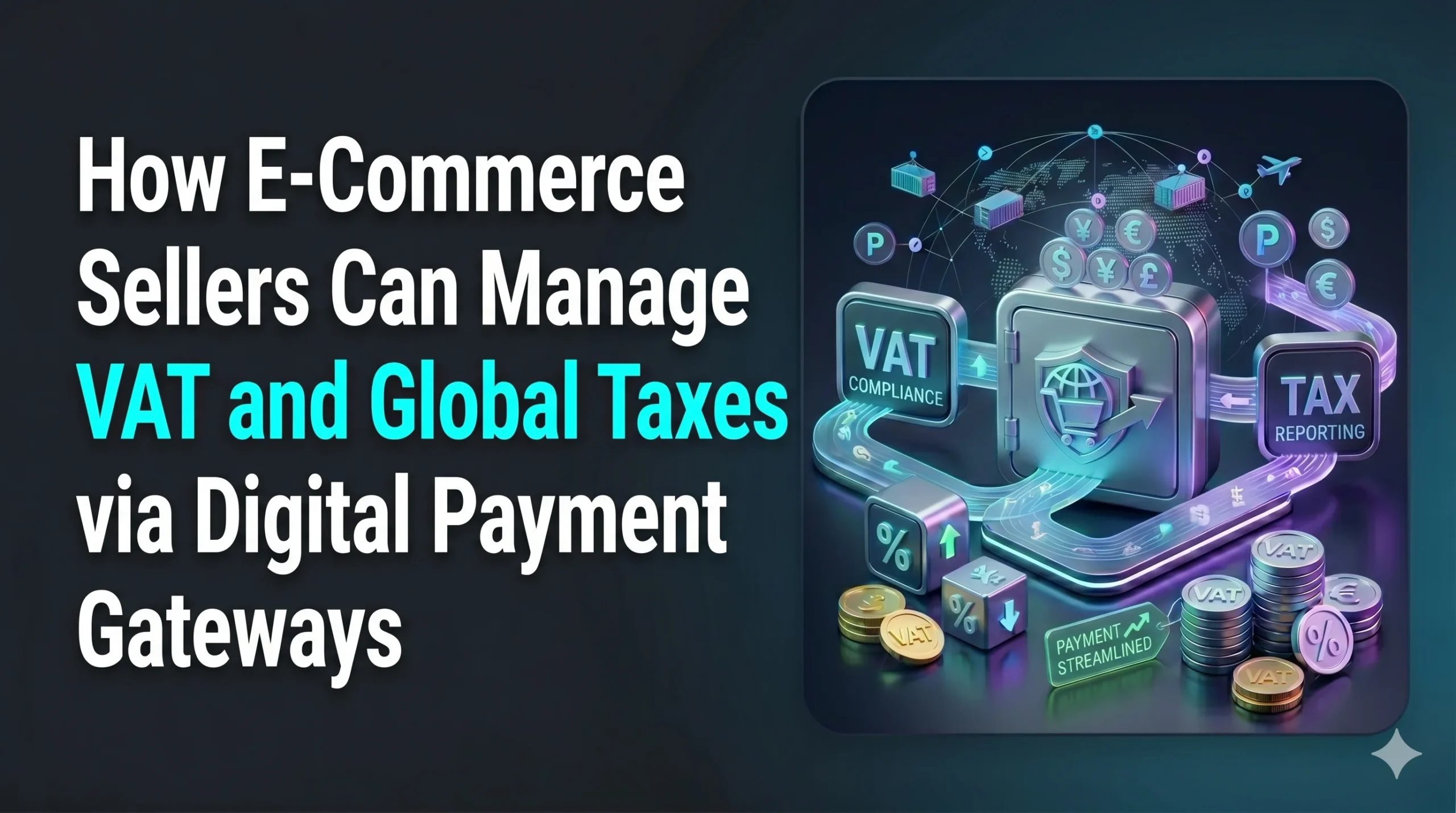
This guide explains how e-commerce sellers can use digital payment gateways to manage VAT and global taxes more efficiently while reducing administrative complexity and improving financial transparency.
Why VAT and Global Tax Compliance Is Becoming More Complex
Cross-border e-commerce taxation has evolved rapidly over the last several years.
Governments worldwide are tightening regulations around:
- Digital commerce reporting
- Marketplace taxation
- VAT/GST collection
- Cross-border supplier transactions
- Beneficial ownership disclosure
For international sellers, this creates a fragmented compliance environment where tax obligations vary by:
- Customer location
- Inventory location
- Sales thresholds
- Product category
- Marketplace structure
A business selling globally may simultaneously face:
- EU VAT obligations
- UK VAT registration requirements
- US marketplace facilitator rules
- GST obligations in countries like Australia or Canada
Without organized payment and reporting infrastructure, tax compliance becomes difficult to manage accurately.
Understanding VAT in Cross-Border E-Commerce
What Is VAT?
VAT (Value Added Tax) is a consumption tax applied at different stages of the supply chain.
Unlike traditional sales tax systems, VAT is generally collected incrementally throughout production and distribution.
Many jurisdictions require international e-commerce sellers to:
- Register for VAT
- Charge VAT to customers
- File periodic VAT returns
- Maintain digital transaction records
Common Regions With VAT/GST Requirements
International sellers frequently encounter:
- EU VAT
- UK VAT
- Canadian GST/HST
- Australian GST
- UAE VAT
- Singapore GST
Each system has:
- Different thresholds
- Filing rules
- Registration triggers
- Documentation requirements
How Digital Payment Gateways Help Manage Global Taxes
Digital payment gateways are no longer just transaction processors.
Modern fintech platforms increasingly function as:
- Treasury management systems
- Multi-currency accounting hubs
- Transaction data infrastructure layers
This becomes especially important for businesses processing large volumes of international payments.
Key Tax Challenges Faced by E-Commerce Sellers
1. Multi-Currency Revenue Tracking
International sellers often receive:
- USD from Amazon US
- GBP from Amazon UK
- EUR from Shopify EU customers
- CAD from Walmart Canada
Without centralized reporting, reconciliation becomes fragmented.
Currency fluctuations further complicate:
- Revenue recognition
- Tax reporting
- Profitability calculations
2. Marketplace Fee Reconciliation
Platforms deduct:
- Referral fees
- Advertising costs
- Refunds
- Chargebacks
- fulfillment expenses
Tax reporting requires accurate tracking of:
- Gross sales
- Net revenue
- Tax collected
- Operational expenses
Manual reconciliation becomes difficult at scale.
3. Cross-Border Supplier Payments
Many e-commerce businesses pay suppliers internationally.
This creates additional considerations around:
- Import VAT
- Reverse-charge VAT mechanisms
- FX conversion reporting
- Transfer documentation
Incomplete payment records can create accounting and audit risks.
4. VAT Threshold Monitoring
Some jurisdictions require VAT registration once sellers exceed specific revenue thresholds.
For example:
- EU OSS thresholds
- UK VAT registration limits
- Country-specific digital service thresholds
Without centralized transaction monitoring, businesses may unintentionally trigger compliance obligations.
The Role of Multi-Currency Payment Gateways
Platforms such as:
offer features that can improve tax visibility and reconciliation.
These platforms help businesses:
- Centralize payment records
- Manage multi-currency balances
- Export transaction histories
- Track FX conversions
- Simplify accounting integration
Comparing Traditional Banking vs Digital Payment Gateways
| Feature | Traditional Banks | Digital Payment Gateways |
|---|---|---|
| Multi-currency reporting | Limited | Strong |
| Marketplace integration | Weak | Extensive |
| Transaction export tools | Basic | Advanced |
| FX transparency | Often limited | Better visibility |
| API/accounting integrations | Limited | Extensive |
| Real-time payment visibility | Moderate | Strong |
| VAT reconciliation support | Manual | More automated |
| Cross-border treasury tools | Limited | Advanced |
For growing e-commerce businesses, digital gateways often provide stronger financial visibility than traditional banking infrastructure alone.
VAT Management Through Payment Data Consolidation
Why Consolidation Matters
Many international sellers use:
- Multiple marketplaces
- Different payment processors
- Separate bank accounts
- Various currencies
Without consolidated reporting, VAT calculations become fragmented.
Digital payment platforms can help centralize:
- Incoming marketplace payouts
- Supplier payments
- Currency conversion records
- Withdrawal histories
This improves audit readiness and tax reporting accuracy.
Multi-Currency Accounting and FX Reporting
Foreign exchange management is closely connected to tax compliance.
Businesses must often report:
- Revenue in local accounting currency
- FX gains and losses
- Currency conversion dates
- Settlement values
Why FX Tracking Is Important
Suppose a seller:
- Receives $10,000 USD
- Converts it later into EUR
- Pays suppliers in CNY
Each step may create:
- Realized FX gains/losses
- Accounting adjustments
- Tax implications
Modern fintech platforms can simplify this process by maintaining:
- Transaction timestamps
- Conversion histories
- Multi-currency balance tracking
Marketplace Facilitator Tax Rules
Many marketplaces now collect and remit taxes automatically in certain jurisdictions.
Examples include:
- Amazon Marketplace Facilitator Tax
- eBay VAT collection
- Etsy marketplace VAT handling
However, sellers still remain responsible for:
- Reporting obligations
- Business registration compliance
- Income tax declarations
- Recordkeeping
A common misconception is that marketplace tax collection eliminates all tax responsibilities. In practice, compliance obligations often remain broader than marketplace-collected VAT alone.
Accounting Integrations and Automation
One of the biggest advantages of digital payment gateways is integration capability.
Many platforms connect directly with:
These integrations can automate:
- Transaction imports
- Currency conversion entries
- VAT categorization
- Invoice reconciliation
- Expense tracking
Automation becomes increasingly valuable as transaction volume grows.
Digital Invoicing and Tax Documentation
Cross-border tax compliance depends heavily on documentation quality.
International sellers should maintain:
- Supplier invoices
- Marketplace payout reports
- VAT invoices
- FX conversion records
- Payment confirmations
Digital payment platforms help centralize these records for:
- Audit preparation
- VAT return filing
- Financial reporting
- Regulatory reviews
Common VAT Mistakes Made by E-Commerce Sellers
1. Assuming Marketplace VAT Collection Covers Everything
Even when marketplaces collect VAT, sellers may still need:
- VAT registration
- Periodic filings
- Accounting records
- Corporate tax reporting
2. Ignoring Currency Conversion Records
FX reporting errors can distort:
- Revenue calculations
- Profit reporting
- Tax liabilities
Maintaining accurate conversion records is essential.
3. Using Personal Accounts for Business Transactions
Mixing personal and business payments complicates:
- Audit trails
- Expense categorization
- VAT reconciliation
- Compliance reporting
Dedicated business payment infrastructure improves financial visibility.
4. Failing to Track Cross-Border Supplier Costs
Import VAT, customs duties, and supplier payment fees can materially affect profitability.
Incomplete expense tracking leads to inaccurate margin analysis.
Compliance and Regulatory Considerations
Digital payment providers increasingly operate under strict:
- KYC requirements
- AML regulations
- Cross-border reporting obligations
Sellers should expect requests for:
- Business registration documents
- Tax identification numbers
- Beneficial ownership verification
- Source-of-funds documentation
Maintaining organized records reduces operational disruption during reviews.
Best Practices for International Sellers
Centralize Payment Infrastructure
Using fewer, well-integrated payment systems improves:
- Financial visibility
- Reconciliation accuracy
- Tax reporting consistency
Maintain Separate Currency Balances Strategically
Holding balances in:
- USD
- EUR
- GBP
can reduce unnecessary currency conversion costs while improving treasury flexibility.
Automate Reporting Where Possible
Automation reduces:
- Manual entry errors
- Reconciliation delays
- Tax reporting inconsistencies
This becomes increasingly important for multi-marketplace businesses.
Work With International Tax Professionals
VAT rules vary significantly by jurisdiction.
Professional guidance may help businesses:
- Avoid penalties
- Optimize reporting structures
- Understand marketplace obligations
- Navigate cross-border tax complexity
How Payment Gateways Improve Operational Scalability
As businesses expand globally, payment infrastructure becomes a core operational layer rather than a simple transaction tool.
Scalable payment systems improve:
- Treasury visibility
- Compliance readiness
- FX management
- Multi-marketplace reconciliation
- International expansion efficiency
For remote-first e-commerce businesses, integrated payment infrastructure often becomes essential for sustainable growth.
Frequently Asked Questions
Do payment gateways automatically handle VAT compliance?
Not entirely. While some platforms help with transaction tracking and reporting, businesses remain responsible for broader tax compliance obligations.
Can digital payment gateways simplify multi-currency tax reporting?
Yes. Many platforms provide transaction exports, FX tracking, and accounting integrations that improve reconciliation accuracy.
Do marketplaces like Amazon and eBay collect VAT automatically?
In certain jurisdictions, yes. However, sellers may still need VAT registration, reporting, and recordkeeping depending on local laws.
Why is FX tracking important for tax compliance?
Currency conversion can create reportable FX gains or losses that affect accounting records and taxable income calculations.
Final Thoughts
As global e-commerce becomes increasingly regulated, tax compliance is evolving into a major operational priority for international sellers.
Managing VAT and global taxes manually across:
- Multiple marketplaces
- Different currencies
- Various jurisdictions
- Cross-border supplier networks
can quickly become unsustainable without centralized financial infrastructure.
Digital payment gateways such as Payoneer, Wise Business, Stripe, and Airwallex increasingly provide tools that improve:
- Transaction visibility
- Multi-currency reconciliation
- Treasury management
- Accounting automation
- Tax reporting workflows
However, no payment platform fully replaces professional tax planning or jurisdiction-specific compliance expertise.
Before selecting payment infrastructure, e-commerce businesses should evaluate:
- FX transparency
- Reporting capabilities
- Accounting integrations
- Compliance support
- Scalability requirements
- Marketplace compatibility
A structured approach to global payments and tax management can help international sellers reduce administrative friction, improve financial visibility, and scale cross-border operations more sustainably over time.