For freelancers, remote professionals, digital agencies, and e-commerce sellers, managing international payments efficiently has become a critical part of running a sustainable online business.
However, many cross-border businesses face the same operational challenges:
- Clients prefer paying through local bank transfers
- International wire fees reduce revenue
- Currency conversion spreads impact profitability
- Opening foreign bank accounts is often difficult
- Payment delays create cash-flow instability
These issues are especially common among freelancers working with international clients through platforms like Upwork or sellers operating on global marketplaces such as Amazon.
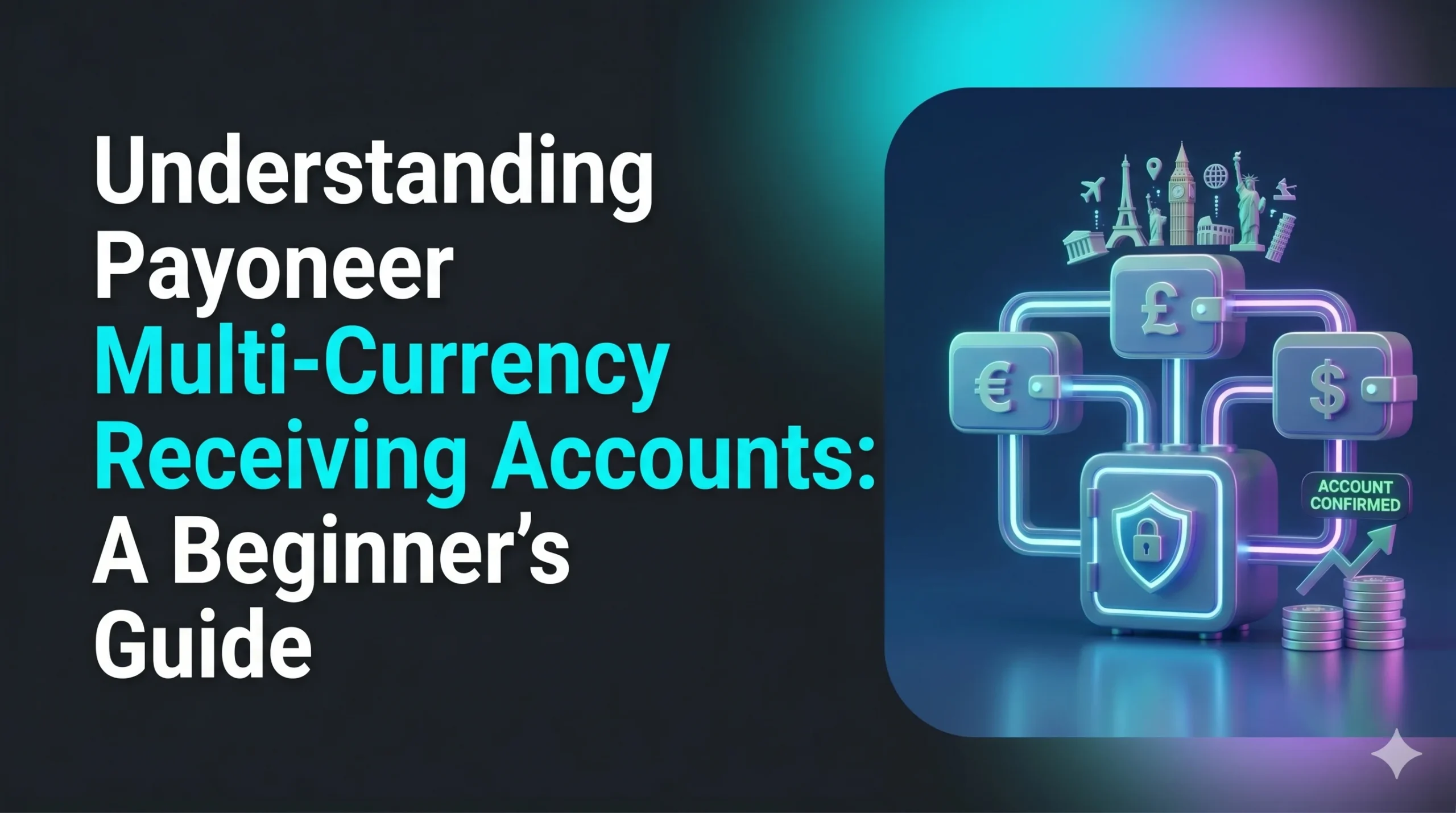
To address these problems, fintech providers have introduced multi-currency receiving accounts — a system that allows businesses to receive foreign payments without maintaining physical bank accounts in multiple countries.
One of the most widely used solutions in this category is Payoneer.
This beginner’s guide explains how Payoneer multi-currency receiving accounts work, who they are designed for, their advantages and limitations, and what businesses should understand before relying on them for international payments.
What Is A Multi-Currency Receiving Account?
A multi-currency receiving account allows users to receive payments in foreign currencies using local banking details issued in supported countries or regions.
Instead of opening:
- A US bank account
- A UK bank account
- A European IBAN account
users can access virtual receiving account details through a fintech provider.
These details may include:
- Account numbers
- Routing numbers
- IBANs
- Sort codes
- ACH-compatible banking credentials
This enables international clients to pay businesses as if they were making a domestic transfer.
Why Businesses Use Multi-Currency Receiving Accounts
Traditional cross-border payments often rely on:
- SWIFT wire transfers
- Intermediary banking networks
- Manual international settlements
These systems may involve:
- Higher fees
- Delayed processing
- Poor exchange rates
- Limited transparency
For smaller businesses and freelancers, these inefficiencies can materially affect revenue retention.
Multi-currency receiving infrastructure helps simplify:
- International invoicing
- Client billing
- Marketplace payouts
- Cross-border cash flow
How Payoneer Multi-Currency Receiving Accounts Work
Payoneer provides eligible users with local receiving account details in selected currencies.
Depending on account eligibility and region, users may receive:
- USD receiving accounts
- EUR receiving accounts
- GBP receiving accounts
- CAD receiving accounts
- AUD receiving accounts
Clients can then send payments through local banking rails instead of expensive international wires.
Example Workflow
Step 1: Create A Payoneer Account
Users register and complete:
- Identity verification
- Address verification
- Compliance review
- Banking setup
Because Payoneer operates within regulated financial frameworks, KYC (Know Your Customer) procedures are required.
Step 2: Access Receiving Account Details
Once approved, users may gain access to:
- US ACH receiving details
- European IBAN information
- UK local banking credentials
These details can then be shared with international clients.
Step 3: Receive International Payments
Clients pay through:
- Domestic bank transfers
- Marketplace payouts
- B2B payment workflows
Funds appear within the Payoneer balance after processing.
Step 4: Hold, Convert, Or Withdraw Funds
Users may then:
- Hold balances in foreign currencies
- Convert currencies
- Withdraw to local bank accounts
- Use Payoneer-supported cards (where available)
This creates more flexibility compared to traditional international banking alone.
Who Commonly Uses Payoneer Receiving Accounts?
Freelancers
Freelancers working with:
- International clients
- Remote contracts
- Marketplace platforms
often use Payoneer to simplify global payments.
Popular use cases include:
- Web development
- Design services
- Consulting
- Content creation
- Marketing retainers
Marketplace Sellers
Payoneer is heavily integrated into global seller ecosystems.
Many sellers use it for payouts from:
- Amazon
- Walmart Marketplace
- eBay
- Affiliate networks
This helps businesses consolidate international marketplace revenue.
Digital Agencies
Agencies managing overseas clients may use Payoneer for:
- Client invoicing
- Contractor payouts
- Multi-currency cash flow management
Key Features Of Payoneer Multi-Currency Accounts
Local Receiving Capabilities
One of the biggest advantages is the ability to receive:
- USD payments through US banking rails
- EUR payments through European banking systems
- GBP transfers locally within the UK
This improves payment efficiency significantly.
Marketplace Integration
Payoneer’s ecosystem is particularly strong for:
- Freelance marketplaces
- Affiliate platforms
- E-commerce seller networks
This differentiates it from some banking alternatives.
Currency Flexibility
Users may:
- Hold multiple currencies
- Delay conversions
- Withdraw strategically
- Manage liquidity more efficiently
This can help businesses navigate currency volatility.
Global Accessibility
Payoneer supports businesses in many regions where:
- Traditional international banking access is limited
- Opening foreign bank accounts is difficult
- SWIFT fees are disproportionately high
Understanding Payoneer Fees
Before relying on any cross-border payment infrastructure, businesses should understand the full fee structure.
Common Payoneer Costs
Currency Conversion Fees
Payoneer typically applies a currency conversion spread above the interbank or mid-market exchange rate.
This is often one of the most important costs to evaluate.
Withdrawal Fees
Withdrawal charges may vary depending on:
- Country
- Currency
- Banking route
- Withdrawal method
Card & Payment Processing Fees
If clients pay through credit cards or other payment methods, additional fees may apply.
Why Exchange Rates Matter
Many users focus only on visible transaction fees while ignoring foreign exchange spreads.
For example:
- A 2% conversion spread on $10,000 equals $200 in implicit conversion cost
Over time, these costs compound significantly for businesses handling recurring international revenue.
Always evaluate:
- Final converted amount
- Real mid-market exchange rate
- Total effective payout
rather than focusing exclusively on advertised transfer fees.
Advantages Of Payoneer Receiving Accounts
Simplified International Payments
Clients can pay locally without:
- International wire complexity
- SWIFT delays
- Additional intermediary banking charges
Strong Marketplace Ecosystem
Payoneer performs especially well for:
- Marketplace freelancers
- Affiliate marketers
- E-commerce sellers
because of its integration infrastructure.
Better Cash-Flow Flexibility
Businesses can:
- Hold foreign currencies
- Withdraw strategically
- Manage timing of conversions
This improves operational flexibility.
Potential Limitations To Consider
FX Conversion Markups
While Payoneer improves payment accessibility, exchange-rate spreads may reduce net payouts compared to some competitors.
Businesses handling large volumes should compare effective FX costs carefully.
Compliance Reviews
Like most regulated fintech providers, Payoneer operates under:
- AML regulations
- KYC requirements
- Fraud monitoring systems
As a result, users may occasionally experience:
- Verification reviews
- Temporary payment holds
- Documentation requests
This is common across global payment infrastructure.
Region-Specific Restrictions
Certain services or receiving currencies may not be available in all countries.
Availability depends on:
- Regulatory environment
- User location
- Account type
- Compliance eligibility
Payoneer vs Traditional Banking
| Feature | Payoneer Receiving Accounts | Traditional Bank Accounts |
|---|---|---|
| Multi-Currency Support | Strong | Limited |
| Foreign Bank Account Required | No | Usually yes |
| Marketplace Integration | Extensive | Minimal |
| International Accessibility | High | Country dependent |
| FX Transparency | Moderate | Variable |
| Setup Speed | Faster | Often slower |
| SWIFT Dependency | Reduced | High |
Payoneer vs Wise: Beginner Perspective
| Feature | Payoneer | Wise |
|---|---|---|
| Marketplace Integration | Strong | Limited |
| Multi-Currency Accounts | Yes | Yes |
| FX Transparency | Moderate | Higher |
| E-Commerce Support | Strong | Moderate |
| Direct Client Invoicing | Good | Excellent |
| Global Payout Infrastructure | Strong | Moderate |
For beginners:
- Payoneer often works better for marketplaces and platform payouts
- Wise may offer more transparent exchange-rate structures for direct transfers
Many businesses eventually use both platforms depending on workflow requirements.
Best Practices For Beginners
Keep Business Documentation Organized
Maintain:
- Invoices
- Client agreements
- Payment records
- Tax documentation
This helps during compliance reviews and operational scaling.
Compare Effective Conversion Rates
Do not evaluate providers using only visible fees.
Instead compare:
- Final payout amount
- Conversion spread
- Withdrawal costs
- Transfer timing
Avoid Frequent Small Withdrawals
Repeated withdrawals may increase:
- Conversion losses
- Banking charges
- Operational inefficiencies
Some businesses reduce costs by consolidating transfers.
Diversify Payment Infrastructure
Experienced freelancers and agencies often use:
- Payoneer for marketplace payouts
- Wise for FX optimization
- Local banking for domestic operations
This improves flexibility and operational resilience.
Final Thoughts
Multi-currency receiving accounts have significantly changed how freelancers, agencies, and e-commerce businesses manage international payments.
Instead of relying entirely on expensive international wire transfers or opening foreign bank accounts, businesses can now:
- Receive local payments globally
- Access multiple currencies
- Improve invoicing workflows
- Reduce cross-border payment friction
Payoneer remains one of the most widely used platforms in this space, particularly for marketplace sellers and remote professionals.
However, businesses should still evaluate:
- Currency conversion costs
- Withdrawal fees
- Compliance requirements
- Operational suitability
before deciding whether Payoneer aligns with their specific payment workflow.
Frequently Asked Questions
What is a Payoneer multi-currency receiving account?
A Payoneer multi-currency receiving account provides local banking details in supported currencies, allowing users to receive international payments without opening foreign bank accounts.
Can freelancers receive USD payments through Payoneer?
Yes. Eligible users can receive USD payments using US receiving account details provided by Payoneer.
Does Payoneer charge currency conversion fees?
Yes. Payoneer generally applies exchange-rate markups during currency conversion and withdrawals.
Is Payoneer suitable for Amazon sellers?
Yes. Many Amazon sellers use Payoneer for international marketplace payouts and multi-currency revenue management.
Explore More Global Payment Insights
Cross-border payment infrastructure can significantly impact operational efficiency, liquidity management, and revenue retention.
Explore more fintech comparisons, marketplace payout guides, and international invoicing resources on Vimzer.xyz to better optimize your global payment operations.