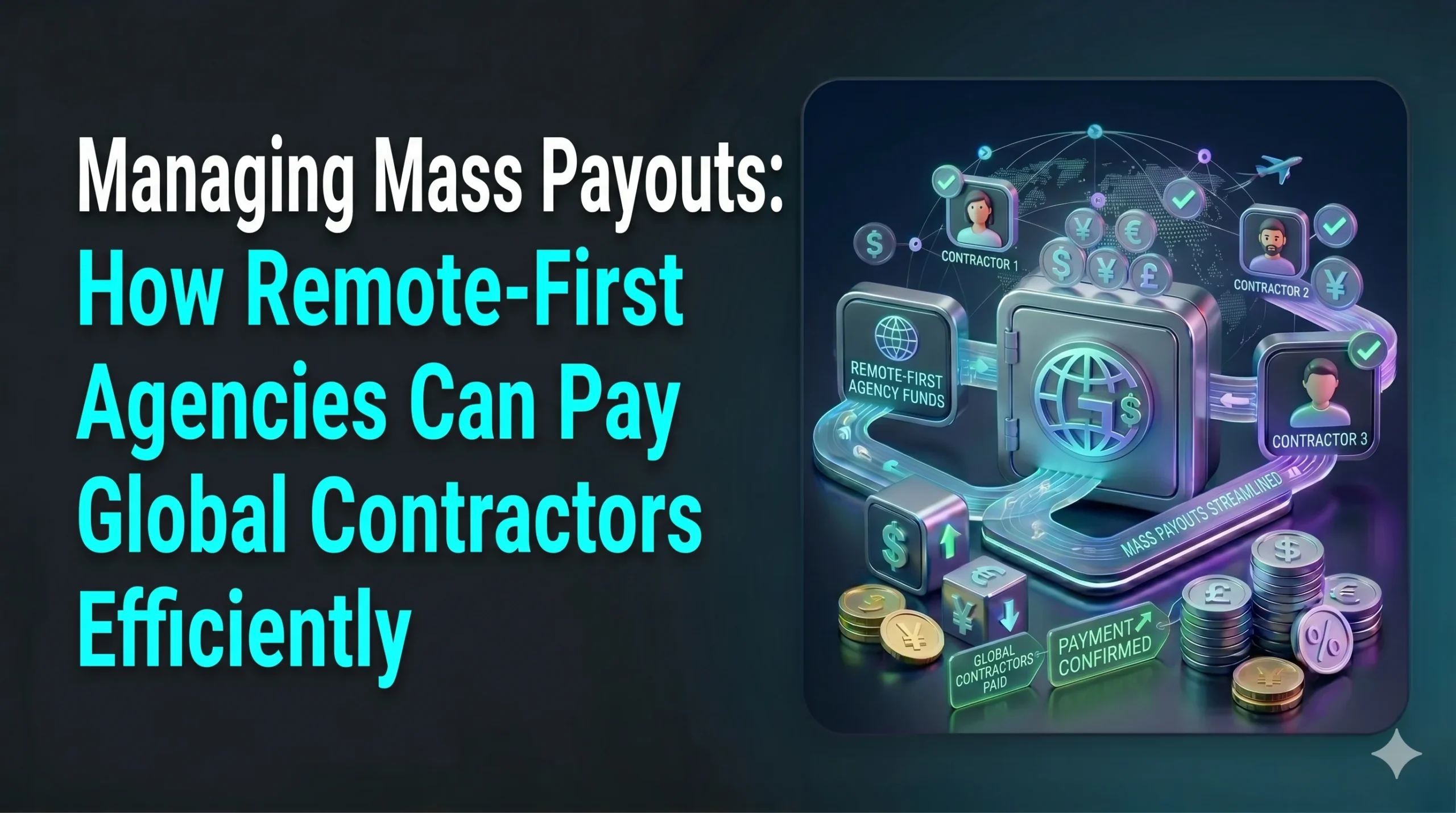
The rise of remote-first business models has fundamentally changed how agencies build and scale teams. Digital agencies today routinely work with designers in Eastern Europe, developers in South Asia, media buyers in Latin America, copywriters in Southeast Asia, and consultants across North America and Western Europe.
This distributed workforce model provides agencies with:
- Access to global talent
- Lower operational overhead
- Flexible scaling capacity
- Around-the-clock productivity
However, managing international contractor payments at scale introduces operational and financial challenges that many agencies underestimate.
As contractor networks expand, agencies often struggle with:
- Cross-border payout delays
- Currency conversion inefficiencies
- High transfer fees
- Fragmented payment systems
- Manual reconciliation workflows
- Contractor onboarding compliance
- Inconsistent payout schedules
For remote-first businesses, mass payout infrastructure is no longer simply an accounting task. It directly affects:
- Contractor retention
- Cash flow management
- Operational efficiency
- Regulatory compliance
- Agency scalability
This guide explores how remote-first agencies can optimize global contractor payouts while reducing cross-border friction, improving treasury visibility, and building more scalable financial operations.
Why Mass Payout Infrastructure Matters for Remote Agencies
In the early stages, many agencies manage contractor payments manually through:
- Bank wires
- PayPal transfers
- Spreadsheet tracking
- Individual invoices
While manageable for small teams, this approach becomes operationally inefficient as agencies scale internationally.
A remote-first agency with:
- 30–100 global contractors
- Multiple currencies
- Recurring monthly payouts
- International compliance requirements
can quickly encounter serious administrative bottlenecks.
Poor payout infrastructure often leads to:
- Delayed payments
- Contractor dissatisfaction
- Reconciliation errors
- Increased finance overhead
- Liquidity inefficiencies
Efficient disbursement systems help agencies maintain operational stability as distributed teams grow.
Common Challenges in Global Contractor Payments
1. Cross-Border Transfer Fees
Traditional international bank wires often involve:
- SWIFT fees
- Intermediary banking charges
- Receiving bank deductions
These costs accumulate rapidly when agencies process dozens or hundreds of monthly payouts.
Example
An agency paying:
- 50 contractors monthly
- With an average $20 transfer cost
could spend:
- $1,000 monthly
- $12,000 annually
on payout infrastructure alone.
2. Currency Conversion Losses
Global agencies often:
- Invoice clients in USD or EUR
- Pay contractors in local currencies
Every currency conversion introduces:
- FX spreads
- Conversion fees
- Exchange-rate volatility
Even modest FX inefficiencies can significantly reduce margins over time.
3. Manual Payment Operations
Many agencies still rely on:
- Individual bank transfers
- Manual invoice approvals
- Spreadsheet-based reconciliation
This creates:
- Operational delays
- Human error risk
- Finance team overload
As contractor volume grows, manual payout management becomes increasingly unsustainable.
4. Compliance and Verification Requirements
Cross-border payments are heavily regulated.
Payment providers increasingly require:
- KYC verification
- Tax documentation
- Contractor identity validation
- Beneficial ownership reviews
Agencies lacking structured onboarding workflows may experience:
- Payout delays
- Compliance holds
- Operational interruptions
Understanding Mass Payout Infrastructure
Mass payouts refer to systems that allow businesses to:
- Pay multiple recipients simultaneously
- Automate recurring disbursements
- Manage multi-currency settlements
- Track payment statuses centrally
These systems are commonly used by:
- Remote-first agencies
- Freelance marketplaces
- SaaS companies
- Affiliate networks
- E-commerce businesses
Modern payout infrastructure increasingly functions as treasury management infrastructure rather than simple payment processing.
Traditional Banking vs Modern Fintech Payout Platforms
Historically, agencies relied heavily on traditional banking systems for contractor payments.
However, fintech platforms now offer infrastructure specifically designed for distributed workforces.
Traditional Bank Transfers
Advantages
- Established global banking rails
- High transaction limits
- Familiar infrastructure
Limitations
- Slow settlement times
- Expensive international transfers
- Poor FX transparency
- Manual operational workflows
For agencies managing high contractor volume, traditional banking often becomes operationally inefficient.
Fintech Mass Payout Platforms
Platforms such as:
provide infrastructure tailored for:
- Multi-currency contractor payouts
- Distributed workforce management
- Treasury automation
- Cross-border payroll operations
Comparing Payout Infrastructure Options
| Feature | Traditional Banks | Fintech Payout Platforms |
|---|---|---|
| Multi-currency payouts | Limited | Strong |
| FX transparency | Often limited | Better visibility |
| Batch payout functionality | Weak | Advanced |
| Settlement speed | Slower | Faster |
| Contractor onboarding tools | Minimal | Extensive |
| Treasury visibility | Limited | Strong |
| API integrations | Basic | Advanced |
| Scalability for remote agencies | Moderate | High |
For globally distributed agencies, fintech payout systems often provide stronger operational flexibility.
Why Multi-Currency Infrastructure Is Essential
Remote-first agencies commonly:
- Collect revenue in USD or EUR
- Pay contractors across multiple currencies
Without multi-currency infrastructure, agencies may face:
- Repeated conversion losses
- Inefficient treasury management
- Unpredictable payout costs
Multi-Currency Receiving Accounts
Platforms offering multi-currency receiving accounts allow agencies to:
- Hold USD, EUR, GBP, and other currencies
- Reduce forced conversions
- Improve treasury control
- Optimize payout timing
This helps agencies reduce unnecessary currency cycling.
Avoiding Double Currency Conversion
A common inefficiency occurs when agencies:
- Receive USD
- Convert to local currency
- Re-convert funds into contractor currencies
Each step introduces additional FX spreads.
Direct contractor payouts in original settlement currencies can significantly reduce operational costs.
Automating Contractor Payout Workflows
Why Automation Matters
Manual payout workflows become increasingly risky as agencies scale.
Automation improves:
- Payment consistency
- Operational speed
- Reconciliation accuracy
- Finance team efficiency
Key Automation Features
Batch Payments
Allows agencies to:
- Pay dozens or hundreds of contractors simultaneously
- Reduce administrative overhead
- Simplify payout cycles
Scheduled Payouts
Recurring payment scheduling improves:
- Contractor trust
- Operational predictability
- Treasury planning
Centralized Payment Dashboards
A unified dashboard improves visibility into:
- Pending payouts
- Settlement statuses
- FX exposure
- Cash flow forecasts
FX Optimization for Remote Agencies
Foreign exchange management is often one of the largest hidden operational expenses for global agencies.
Even small FX inefficiencies can materially impact profitability.
How FX Costs Accumulate
Suppose an agency:
- Processes $150,000 monthly
- Pays contractors across five currencies
- Faces an average 2% FX spread
Annual FX-related costs could exceed:
- $36,000 annually
without structured treasury optimization.
Strategies to Reduce FX Costs
Hold Strategic Currency Balances
Maintaining balances in:
- USD
- EUR
- GBP
can reduce forced conversions during unfavorable exchange-rate conditions.
Compare Effective Exchange Rates
The important metric is:
Effective settlement rate vs interbank rate
Advertised “low fees” may still conceal wide FX spreads.
Consolidate Conversion Events
Reducing the number of individual conversions can improve:
- Treasury efficiency
- FX consistency
- Cash flow predictability
Contractor Experience and Retention
Reliable payout infrastructure directly affects contractor relationships.
Late or inconsistent payments can:
- Reduce retention
- Damage morale
- Increase churn risk
Agencies with efficient payout systems often gain advantages in:
- Talent acquisition
- Contractor loyalty
- Operational stability
This becomes increasingly important in competitive global talent markets.
Compliance and Regulatory Considerations
Mass cross-border payouts involve significant regulatory oversight.
Agencies should expect:
- KYC requirements
- AML monitoring
- Contractor verification
- Tax documentation requests
- Beneficial ownership reviews
Common Compliance Documents
Agencies may need:
- W-8BEN forms
- W-9 forms
- Contractor agreements
- Business registration records
- Tax identification numbers
Maintaining centralized documentation reduces payout disruptions.
Tax and Accounting Complexity
Global contractor payouts introduce accounting challenges around:
- Multi-currency bookkeeping
- Expense categorization
- FX gains/losses
- International tax reporting
Without structured reconciliation workflows, agencies may struggle with:
- Audit readiness
- Financial visibility
- Accurate profitability reporting
Accounting and ERP Integrations
Modern payout systems increasingly integrate with:
These integrations help automate:
- Contractor expense tracking
- Multi-currency reconciliation
- Financial reporting
- Tax preparation
Automation becomes increasingly valuable as payout volume scales.
Best Practices for Remote-First Agencies
Standardize Contractor Onboarding
Create structured onboarding workflows that include:
- Payment method collection
- Tax forms
- Identity verification
- Currency preferences
Centralize Treasury Management
Fragmented payment systems create operational inefficiency.
Centralized treasury infrastructure improves:
- Liquidity forecasting
- FX management
- Contractor payout visibility
Diversify Payment Infrastructure
Relying on a single payout provider creates operational risk.
Many agencies maintain:
- Primary payout platform
- Secondary treasury provider
- Backup banking rails
This improves operational resilience.
Monitor Payment Timing Metrics
Track:
- Average payout settlement time
- Failed payment rates
- FX conversion costs
- Contractor payment satisfaction
Operational visibility supports better scaling decisions.
When Agencies Should Upgrade Their Payout Infrastructure
Agencies often outgrow manual systems when they:
- Expand internationally
- Hire across multiple regions
- Exceed 20–30 monthly contractor payouts
- Manage multiple currencies
- Experience reconciliation bottlenecks
At this stage, treasury automation becomes operationally necessary rather than optional.
Frequently Asked Questions
What is the most efficient way to pay international contractors?
The optimal solution depends on:
- Contractor geography
- Payout volume
- Currency requirements
- Compliance complexity
Fintech mass payout platforms often reduce friction compared to traditional wire transfers.
Why are FX spreads important for remote agencies?
FX spreads directly affect payout costs and operating margins, particularly for agencies processing large monthly contractor disbursements.
Can agencies automate recurring contractor payments?
Yes. Many modern payout platforms support:
- Batch payments
- Scheduled disbursements
- Multi-currency payout automation
Are traditional bank wires still practical for contractor payouts?
They remain useful for some high-value transfers, but fintech payout systems generally provide better scalability for distributed contractor operations.
Final Thoughts
For remote-first agencies, contractor payout infrastructure has become a core operational layer rather than a back-office administrative task.
As distributed workforces continue expanding globally, agencies that optimize:
- Cross-border disbursements
- FX management
- Multi-currency treasury workflows
- Contractor onboarding
- Payout automation
- Financial reporting systems
are often better positioned to scale sustainably.
Platforms such as Payoneer, Wise Business, Deel, Remote, and Airwallex increasingly provide infrastructure tailored for global contractor management, though the right solution depends heavily on payout geography, compliance needs, and treasury complexity.
Before selecting payout infrastructure, agencies should evaluate:
- FX transparency
- Batch payout functionality
- Settlement speed
- Contractor experience
- Compliance support
- Accounting integrations
- Long-term scalability
A well-structured global payout strategy can help agencies reduce operational friction, improve contractor retention, and build more resilient international operations over time.