For digital agencies operating across borders, currency conversion costs are often one of the most underestimated threats to profitability.
An agency may successfully scale international client acquisition, build distributed contractor teams, and secure recurring retainers in multiple currencies—yet still lose a significant percentage of revenue through inefficient foreign exchange (FX) practices.
These losses frequently occur quietly through:
- Hidden FX spreads
- Unfavorable interbank conversion rates
- Double currency conversions
- International wire transfer markups
- Poor treasury timing
- Fragmented payout systems
For agencies managing clients in the United States, Europe, the United Kingdom, the Middle East, or Asia-Pacific regions, even small inefficiencies in cross-border payments can compound into major operational costs over time.
This is especially relevant for:
- SEO agencies
- Media buying firms
- Web development agencies
- Remote creative studios
- SaaS consulting firms
- Distributed marketing teams
As remote-first business models continue to expand globally, agencies increasingly need structured FX and treasury strategies to preserve margins and improve cash flow predictability.
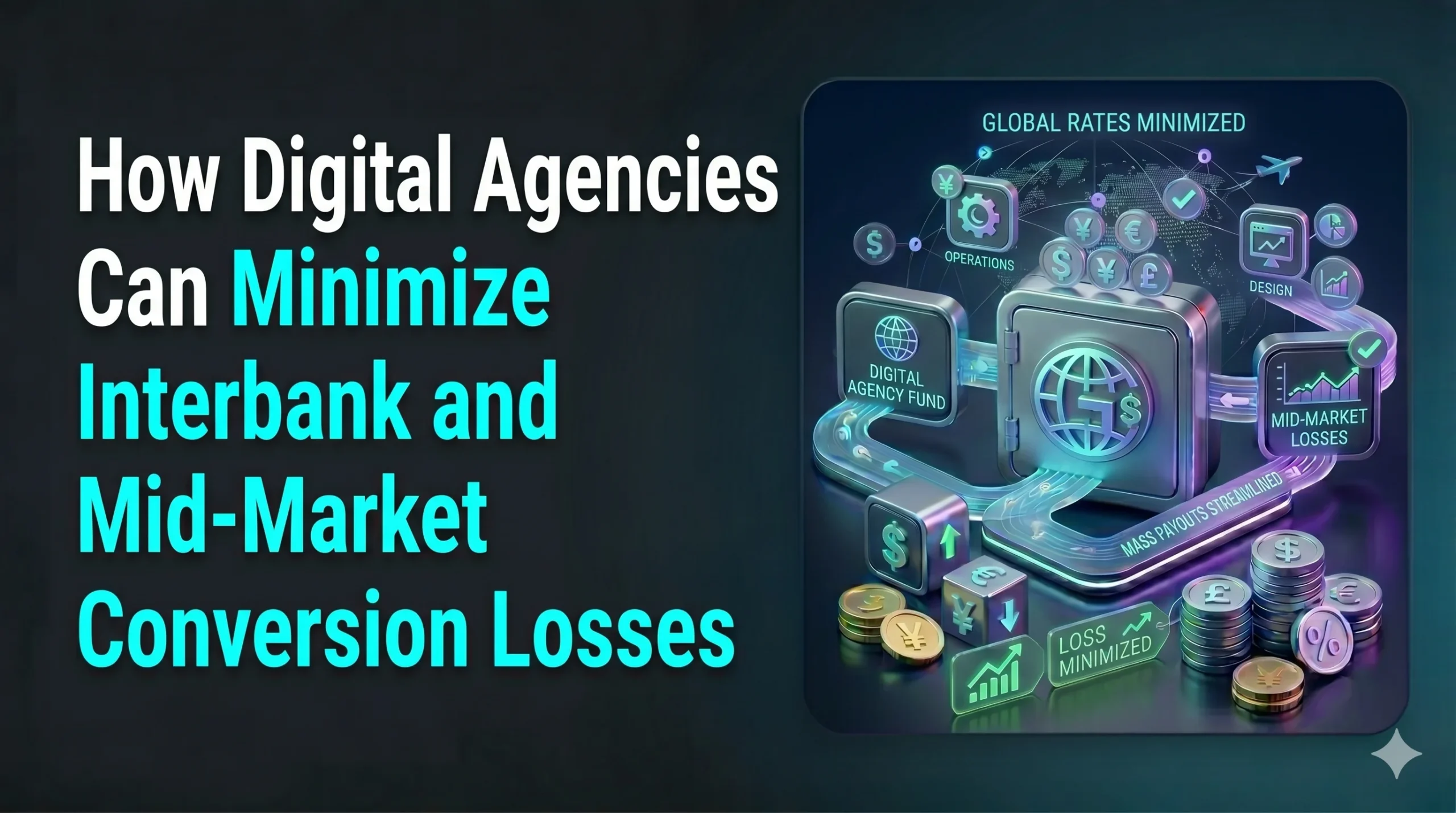
This guide explores how digital agencies can minimize interbank and mid-market conversion losses while building more scalable cross-border financial operations.
Understanding Interbank and Mid-Market Exchange Rates
Before optimizing FX workflows, agencies need to understand how currency pricing works.
What Is the Interbank Rate?
The interbank rate refers to the exchange rate banks use when trading currencies directly with one another in wholesale markets.
It is often:
- The most competitive available exchange rate
- Used as a benchmark for global FX markets
- Sometimes called the “spot rate”
Most businesses do not receive the pure interbank rate directly.
What Is the Mid-Market Rate?
The mid-market rate is generally the midpoint between:
- The buy price
- The sell price
for a currency pair.
Many fintech platforms use the mid-market rate as a reference benchmark because it reflects relatively transparent market pricing.
Why Conversion Losses Happen
Financial institutions and payment providers typically generate revenue through:
- FX spreads
- Conversion markups
- Wire fees
- Settlement fees
This means the actual exchange rate businesses receive is often worse than the publicly quoted mid-market rate.
For agencies processing significant international revenue, these differences materially affect profitability.
Why FX Inefficiencies Matter for Digital Agencies
Cross-border agencies operate in a uniquely FX-sensitive environment.
A typical agency may:
- Invoice clients in USD
- Pay contractors in EUR and PHP
- Purchase software subscriptions in GBP
- Hold reserves in local currency
Every conversion event introduces potential margin loss.
Example of Hidden FX Costs
Suppose a remote-first agency:
- Processes $100,000 monthly in foreign revenue
- Faces an average 2.5% FX spread
Estimated annual conversion losses:
- Approximately $30,000 annually
without including:
- Wire fees
- Intermediary banking costs
- Treasury timing inefficiencies
For agencies with tighter margins, these losses can significantly affect operational scalability.
Common Sources of Currency Conversion Losses
1. Forced Automatic Currency Conversion
Many payment processors automatically convert incoming funds into local currency.
This removes the agency’s ability to:
- Time conversions strategically
- Hold foreign currency balances
- Compare rates across providers
Automatic conversion often results in:
- Wider spreads
- Lower FX transparency
- Reduced treasury flexibility
2. Double Conversion Cycles
One of the most common treasury inefficiencies occurs when agencies:
- Receive USD
- Convert to local currency
- Re-convert funds into another currency for contractor payouts
Each conversion layer introduces additional spread costs.
This is particularly common in agencies managing distributed global teams.
3. Traditional Banking Markups
Traditional banks frequently add:
- Hidden exchange-rate margins
- SWIFT fees
- Intermediary banking deductions
The final settlement amount may differ significantly from headline FX rates.
4. Fragmented Financial Infrastructure
Agencies using separate systems for:
- Client invoicing
- Contractor payments
- Currency conversion
- Treasury management
often lose visibility into:
- Effective FX costs
- Liquidity exposure
- Conversion timing
This fragmentation reduces financial efficiency.
Why Multi-Currency Infrastructure Matters
Modern fintech infrastructure increasingly allows agencies to:
- Receive funds in multiple currencies
- Hold foreign currency balances
- Delay conversion strategically
- Pay contractors directly in local currencies
This reduces unnecessary conversion events and improves treasury flexibility.
Multi-Currency Receiving Accounts
Platforms such as:
offer multi-currency receiving infrastructure that allows agencies to:
- Hold USD, EUR, GBP, AUD, and other currencies
- Reduce forced conversions
- Improve liquidity management
- Simplify international collections
Comparing Traditional Banks vs Fintech FX Infrastructure
| Feature | Traditional Banks | Fintech Platforms |
|---|---|---|
| FX transparency | Often limited | Better visibility |
| Mid-market rate access | Limited | More competitive |
| Multi-currency holding | Moderate | Strong |
| International payout flexibility | Moderate | High |
| Treasury visibility | Basic | Advanced |
| Settlement speed | Slower | Faster |
| FX management tools | Limited | More sophisticated |
| Scalability for agencies | Moderate | High |
Fintech platforms are not universally cheaper in every corridor, but many offer stronger transparency and operational flexibility for globally distributed agencies.
Strategies to Minimize FX Conversion Losses
1. Hold Foreign Currency Balances Strategically
Instead of converting funds immediately, agencies can:
- Retain balances in USD or EUR
- Convert based on operational needs
- Reduce unnecessary conversion frequency
This provides greater control over treasury timing.
2. Reduce Double Conversion Events
Agencies should aim to:
- Receive funds in one currency
- Pay contractors directly from that balance when possible
Example:
- Receive USD from clients
- Pay USD-compatible contractors directly
This minimizes repeated FX exposure.
3. Compare Effective Settlement Rates
The advertised fee is not the only cost factor.
Agencies should compare:
Effective settlement value vs mid-market benchmark
Some providers advertise:
- “Zero fees”
- “Low-cost transfers”
while embedding wider margins inside FX rates.
4. Consolidate Treasury Operations
Fragmented financial systems create inefficiency.
Centralized treasury management improves:
- Cash flow visibility
- FX tracking
- Liquidity planning
- Conversion timing decisions
5. Monitor FX Exposure by Region
Agencies with large international contractor bases should monitor:
- Currency volatility
- Regional exposure concentration
- Seasonal FX trends
This helps reduce unexpected cost fluctuations.
Treasury Timing and Liquidity Management
Timing matters in cross-border treasury operations.
Agencies converting large balances during periods of:
- Currency volatility
- Market instability
- Economic announcements
may experience significantly different settlement outcomes.
Why Liquidity Planning Matters
Poor treasury timing can lead to:
- Forced conversions during unfavorable rates
- Contractor payout delays
- Reduced operational flexibility
Maintaining strategic liquidity buffers in key currencies can improve resilience.
The Operational Role of Mass Payout Systems
Remote-first agencies often pay:
- Designers
- Developers
- Media buyers
- Account managers
- Freelance consultants
across multiple countries simultaneously.
Mass payout infrastructure helps agencies:
- Automate disbursements
- Reduce banking overhead
- Improve FX coordination
- Simplify reconciliation
This becomes increasingly important as contractor volume grows.
Accounting and Financial Visibility
FX management is closely connected to accounting quality.
Agencies should track:
- Conversion rates
- Settlement dates
- FX gains/losses
- Contractor payment values
- Revenue by currency
Without centralized reporting, financial visibility deteriorates rapidly.
Accounting Integration Infrastructure
Many fintech treasury platforms integrate with:
These integrations help automate:
- Multi-currency reconciliation
- FX reporting
- Contractor expense tracking
- Cash flow analysis
Automation improves scalability for distributed agency operations.
Compliance and Regulatory Considerations
Cross-border financial operations involve significant compliance oversight.
Payment providers increasingly require:
- Business verification
- Beneficial ownership documentation
- Source-of-funds reviews
- Contractor verification
Agencies with poorly documented financial workflows may experience:
- Temporary payout holds
- Delayed settlements
- Enhanced compliance reviews
Maintaining organized treasury documentation improves operational continuity.
Common Mistakes Agencies Make
Ignoring Hidden FX Spreads
Many agencies focus only on transfer fees while overlooking:
- Conversion markups
- Settlement differences
- Embedded exchange-rate margins
FX spreads often represent the largest hidden cost.
Over-Converting Small Balances
Frequent low-value conversions increase:
- Spread losses
- Treasury inefficiency
- Operational complexity
Consolidating conversions can improve cost efficiency.
Using Personal Accounts for Business Treasury
Mixing personal and business finances creates:
- Accounting complications
- Compliance risks
- Poor operational visibility
Dedicated business treasury infrastructure is essential for scaling agencies.
Relying on a Single Payment Rail
Depending entirely on one provider creates operational risk.
Many agencies maintain:
- Primary treasury platform
- Secondary payout provider
- Backup banking infrastructure
This improves resilience during service interruptions or compliance reviews.
Best Practices for Remote-First Agencies
Centralize Multi-Currency Treasury Operations
A unified treasury system improves:
- FX monitoring
- Liquidity management
- Contractor payout coordination
- Financial forecasting
Maintain Currency-Based Budgeting
Track:
- Revenue by currency
- Contractor obligations by currency
- FX exposure concentration
This improves treasury planning accuracy.
Negotiate Better FX Terms at Scale
Larger agencies processing substantial international volume may qualify for:
- Reduced spreads
- Better settlement rates
- Dedicated treasury support
Build Financial Redundancy
Diversified payout and treasury infrastructure improves:
- Operational continuity
- Liquidity flexibility
- Cross-border resilience
Frequently Asked Questions
What is the difference between the interbank and mid-market rate?
The interbank rate is used by banks trading currencies directly, while the mid-market rate is generally the midpoint between buy and sell prices in the FX market.
Why do agencies lose money during currency conversion?
Losses typically occur through:
- FX spreads
- Hidden conversion markups
- Double currency conversions
- Banking fees
Are fintech platforms always cheaper than traditional banks?
Not always. Costs vary by currency corridor, transaction size, and payout method. However, fintech platforms often provide stronger FX transparency and treasury flexibility.
How can agencies reduce FX conversion frequency?
Using multi-currency receiving accounts allows agencies to:
- Hold foreign balances
- Delay conversion strategically
- Pay contractors directly in compatible currencies
Final Thoughts
As digital agencies scale internationally, foreign exchange management increasingly becomes a strategic financial discipline rather than a simple operational necessity.
Agencies that optimize:
- Multi-currency treasury management
- FX conversion timing
- Contractor payout infrastructure
- Cross-border collections
- Liquidity planning
- Financial visibility
are often better positioned to preserve margins and scale sustainably.
Platforms such as Payoneer, Wise Business, Airwallex, and Revolut Business increasingly provide infrastructure designed for global business treasury workflows, though the optimal setup depends heavily on transaction volume, contractor geography, and currency exposure.
Before selecting a cross-border payment solution, agencies should evaluate:
- FX transparency
- Effective settlement rates
- Multi-currency functionality
- Treasury visibility
- Compliance support
- Accounting integrations
- Scalability requirements
A disciplined approach to FX management can help agencies reduce operational leakage, improve cash flow stability, and build more resilient global financial operations over time.