The global workforce is becoming increasingly decentralized. Today, a freelance designer in Lahore can invoice a client in New York, a solo Amazon seller in Berlin can source products from Shenzhen, and a one-person SaaS consultancy can manage customers across five continents without maintaining a physical office.
This shift has created unprecedented opportunities for digital solopreneurs — individuals building international businesses independently through freelancing, e-commerce, content creation, consulting, and remote digital services.
However, despite the borderless nature of online business, international payments infrastructure remains fragmented, expensive, and operationally inefficient in many regions.
Digital solopreneurs still face persistent challenges such as:
- Delayed international settlements
- High foreign exchange (FX) conversion costs
- Compliance-related payment holds
- Platform dependency risks
- Limited banking access
- Multi-currency cash flow complexity
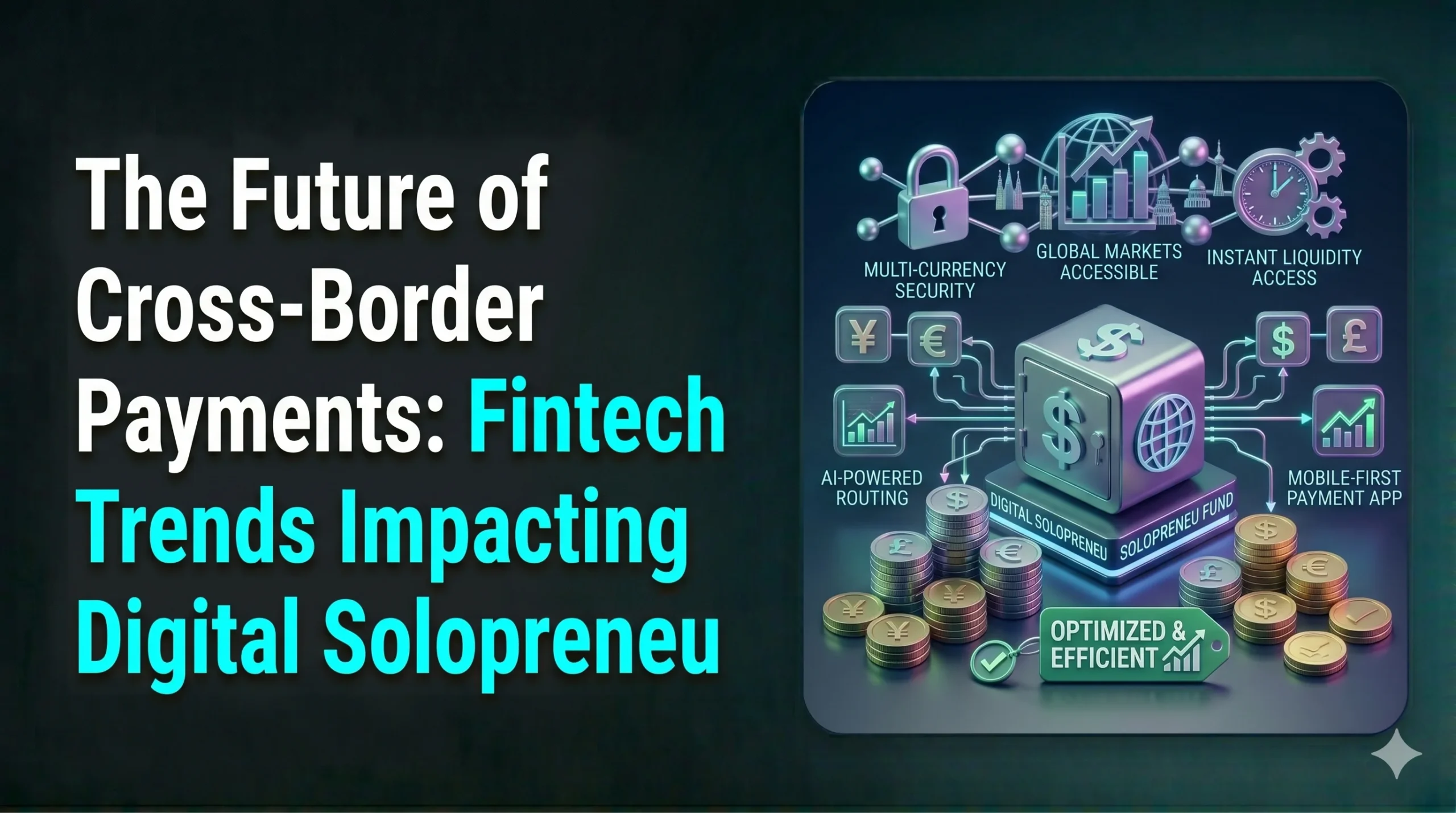
The cross-border payments industry is now undergoing significant transformation. Fintech companies, embedded finance platforms, real-time payment systems, and AI-driven treasury tools are reshaping how independent online businesses move money internationally.
This guide explores the major fintech trends likely to shape the future of cross-border payments — and how these changes may affect freelancers, creators, online sellers, and remote-first solopreneurs over the coming years.
Why Cross-Border Payments Matter More Than Ever
The rise of the digital economy has dramatically expanded the number of individuals earning internationally.
Modern solopreneurs increasingly operate through platforms such as:
- Upwork
- Fiverr
- Amazon
- Etsy
- Shopify
- Gumroad
- YouTube
- Substack
Unlike traditional exporters, these businesses often require:
- Low-cost global collections
- Fast access to liquidity
- Multi-currency flexibility
- International invoicing
- Reliable contractor payouts
- Regulatory compliance support
As a result, payment infrastructure is no longer just a backend financial tool — it has become a competitive operational advantage.
The Traditional Cross-Border Payment Problem
Historically, international payments relied heavily on correspondent banking systems such as SWIFT.
While functional, this model introduced several inefficiencies:
- Multiple intermediary banks
- Slow settlement times
- Opaque FX pricing
- High transfer fees
- Limited payment visibility
For enterprise institutions, these inefficiencies were manageable.
For freelancers and small online businesses, they became disproportionately expensive.
A freelancer receiving a $1,000 international wire could lose a meaningful percentage of income through:
- Wire transfer fees
- Receiving bank charges
- Intermediary deductions
- Currency conversion spreads
This operational friction helped create demand for fintech alternatives.
Trend 1: The Rise of Multi-Currency Financial Infrastructure
One of the most important developments in modern fintech is the expansion of multi-currency receiving infrastructure.
Platforms such as Payoneer, Wise, and Airwallex now provide localized account functionality in major currencies.
Why This Matters for Solopreneurs
Instead of relying entirely on expensive SWIFT wires, users can increasingly:
- Receive local ACH transfers in USD
- Accept SEPA transfers in EUR
- Hold GBP balances
- Delay FX conversion strategically
This improves:
- Cash flow flexibility
- FX cost control
- Treasury visibility
- Operational scalability
For digital businesses with international revenue streams, multi-currency infrastructure is rapidly becoming standard rather than optional.
Trend 2: Real-Time and Faster Cross-Border Payments
Global payment systems are gradually shifting toward faster settlement rails.
Historically, international transfers often required:
- 2–5 business days
- Manual reviews
- Intermediary banking chains
New payment infrastructure increasingly focuses on:
- Real-time settlement
- Instant transfers
- Local clearing systems
- Reduced correspondent banking dependence
Impact on Solopreneurs
Faster settlement directly improves:
- Liquidity access
- Advertising budget management
- Contractor payroll timing
- Supplier payment reliability
For smaller businesses operating with limited working capital, settlement speed can materially affect operational stability.
Trend 3: Embedded Finance and Platform-Native Payments
Increasingly, payment infrastructure is being integrated directly into digital platforms.
This is known as embedded finance.
Examples include:
- Marketplace-native payouts
- Creator monetization wallets
- Platform-integrated business banking
- E-commerce treasury tools
Rather than sending users externally to banks, platforms increasingly manage payments internally.
Benefits
Embedded finance may simplify:
- Global collections
- Contractor payouts
- Revenue reconciliation
- Tax tracking
- Currency management
For solopreneurs, operational simplicity can significantly reduce administrative overhead.
Potential Risks
However, increased platform centralization also creates dependency risk.
If a platform account is suspended or restricted, businesses may temporarily lose access to both:
- Revenue streams
- Treasury infrastructure
This is why many experienced digital businesses maintain diversified payment systems.
Trend 4: AI-Driven Compliance and Fraud Monitoring
Regulatory scrutiny around cross-border payments continues increasing globally.
Fintech providers now rely heavily on:
- AI-driven AML monitoring
- Automated sanctions screening
- Behavioral transaction analysis
- Fraud detection systems
- Risk scoring models
Positive Impacts
AI-based monitoring can improve:
- Fraud prevention
- Identity verification
- Transaction security
- Regulatory scalability
Challenges for Solopreneurs
Automated systems may also create:
- False positives
- Unexpected account reviews
- Temporary payout restrictions
- Increased documentation requests
Freelancers and online businesses with inconsistent revenue patterns are particularly vulnerable to automated compliance triggers.
Trend 5: Increased FX Transparency
Traditional international banking often obscured the real cost of currency conversion through wide exchange-rate markups.
Modern fintech competition is gradually improving transparency around:
- Mid-market exchange rates
- FX spreads
- Conversion timing
- Cross-border settlement costs
Providers emphasizing transparent FX pricing are reshaping user expectations.
Why FX Costs Matter
Many solopreneurs underestimate how much profit disappears through foreign exchange inefficiencies.
For example:
A creator earning $100,000 annually from international clients could lose thousands annually through unfavorable FX conversion spreads.
As competition increases, businesses are becoming more sophisticated about evaluating:
- Effective conversion costs
- Withdrawal timing
- Currency holding strategies
rather than focusing only on visible transfer fees.
Trend 6: Stablecoins and Blockchain-Based Settlement Experiments
Although still evolving, stablecoins and blockchain settlement infrastructure are becoming increasingly relevant in cross-border finance discussions.
Stablecoins aim to combine:
- Faster settlement
- Reduced intermediary costs
- Programmable transfers
- Cross-border accessibility
Some fintech firms are experimenting with blockchain-based treasury infrastructure and international settlement systems.
Potential Benefits
If regulatory clarity improves, blockchain settlement could eventually reduce:
- Transfer latency
- Cross-border friction
- Settlement costs
- Dependency on correspondent banking
Current Limitations
However, major limitations remain:
- Regulatory uncertainty
- Compliance complexity
- Volatility concerns
- Jurisdictional restrictions
- Limited mainstream integration
For most solopreneurs, stablecoins currently remain supplementary rather than primary treasury infrastructure.
Trend 7: The Growth of Global Freelancer Economies
The global freelancer economy continues expanding rapidly.
More professionals now operate independently across:
- Design
- Software development
- Marketing
- Consulting
- Content creation
- E-commerce management
This creates increasing demand for payment systems optimized specifically for:
- Smaller cross-border transactions
- Flexible contractor payouts
- Platform integrations
- Emerging-market accessibility
Fintech providers targeting freelancers and digital SMBs are likely to continue expanding rapidly.
Trend 8: Treasury Management Becoming Mainstream for Small Businesses
Historically, treasury management was associated mainly with large corporations.
Today, even solopreneurs increasingly need to think about:
- Liquidity allocation
- Currency exposure
- Payment redundancy
- FX timing
- Cross-platform diversification
As global online business grows more sophisticated, treasury literacy is becoming operationally valuable even for one-person businesses.
Comparison Table: Emerging Fintech Trends and Their Impact
| Fintech Trend | Potential Benefit | Potential Risk |
|---|---|---|
| Multi-currency accounts | Reduced FX costs | Platform dependency |
| Faster payments | Improved liquidity | Compliance monitoring intensity |
| Embedded finance | Operational simplicity | Centralization risk |
| AI-driven compliance | Better fraud protection | False positives and account reviews |
| FX transparency | Lower hidden costs | Competitive pricing variability |
| Stablecoin settlement | Faster global transfers | Regulatory uncertainty |
| Treasury automation | Better cash flow management | Increased system complexity |
What Solopreneurs Should Do Now
Diversify Payment Infrastructure
Relying on a single payment platform increases operational risk.
Many experienced businesses maintain:
- Multiple payout providers
- Backup withdrawal methods
- Secondary treasury accounts
Learn Basic Treasury Management
Even freelancers benefit from understanding:
- FX conversion timing
- Multi-currency holding strategies
- Liquidity management
- Payment fee structures
Small financial optimizations compound significantly over time.
Maintain Strong Compliance Preparedness
Regulatory scrutiny is likely to increase, not decrease.
Businesses should maintain organized:
- Tax records
- Contracts
- Invoices
- Business registrations
- Source-of-funds documentation
to reduce disruption during compliance reviews.
Focus on Net Revenue, Not Just Gross Revenue
The most financially resilient solopreneurs optimize:
- Payment efficiency
- FX leakage
- Settlement timing
- Treasury stability
rather than focusing solely on top-line sales growth.
FAQ
Will traditional bank wires disappear completely?
Unlikely. Traditional banks still play a major role in enterprise treasury operations and large institutional transfers, although fintech infrastructure is reducing reliance on correspondent banking systems.
Are fintech payment platforms safer than banks?
Regulated fintech providers generally maintain strong security and compliance systems, but businesses should still diversify treasury infrastructure and maintain operational redundancy.
Why are multi-currency accounts becoming more important?
They help businesses reduce unnecessary FX conversions, improve cash flow flexibility, and manage international revenue more efficiently.
Will stablecoins replace traditional cross-border payments?
Stablecoins may influence future settlement infrastructure, but regulatory, compliance, and adoption challenges currently limit mainstream business usage.
Final Thoughts
The future of cross-border payments is increasingly shaped by faster settlement systems, multi-currency infrastructure, embedded finance, and AI-driven compliance technology.
For digital solopreneurs, these changes create both opportunities and new operational responsibilities.
Businesses that understand:
- FX optimization
- Liquidity management
- Compliance preparedness
- Payment diversification
- Treasury resilience
will likely operate more efficiently than competitors relying solely on outdated international banking workflows.
While fintech innovation continues reducing friction in global commerce, no single platform or technology completely eliminates cross-border complexity.
The most resilient solopreneurs are increasingly treating payments infrastructure not merely as a utility, but as a strategic component of long-term business sustainability and international scalability.