For freelancers, Amazon sellers, remote agencies, and digital service providers operating internationally, receiving payments efficiently is often just as important as generating revenue itself.
Traditional international banking systems remain expensive, slow, and operationally fragmented for many small and mid-sized businesses. SWIFT wire fees, intermediary bank deductions, unfavorable exchange rates, and delayed settlements can significantly reduce margins — especially for businesses handling recurring cross-border payments.
This is where fintech infrastructure providers like Payoneer have become increasingly relevant.
Over the past decade, Payoneer has positioned itself as a major cross-border payments platform serving freelancers, marketplace sellers, agencies, and global SMBs. Its ecosystem supports multi-currency receiving accounts, marketplace payouts, contractor disbursements, and international invoicing workflows.
However, despite its popularity, Payoneer is not always the lowest-cost or most flexible option for every business model. Like most global fintech providers, the platform involves trade-offs related to FX conversion fees, compliance monitoring, support responsiveness, and operational limitations.
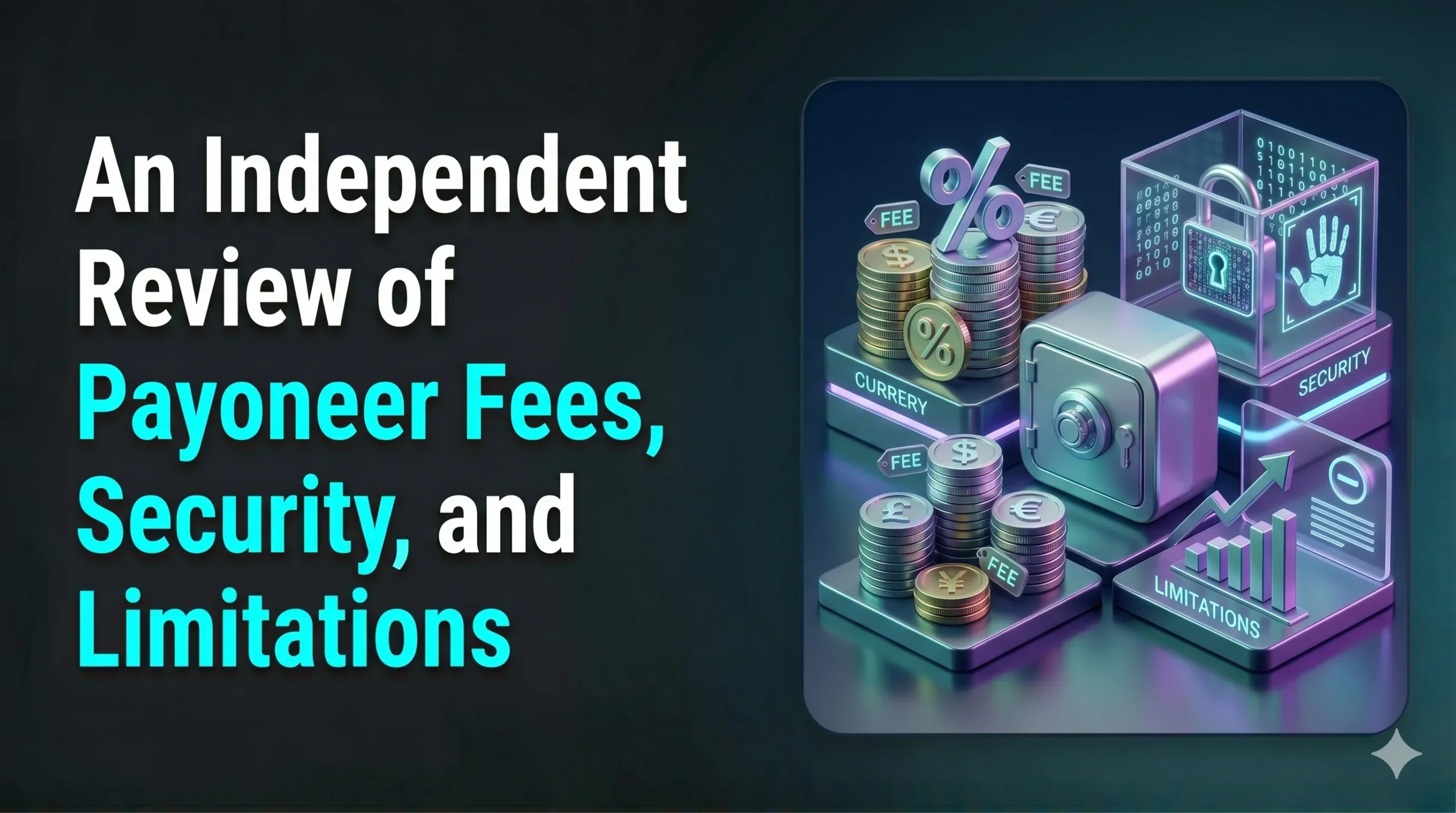
This independent review examines Payoneer’s fee structure, security infrastructure, strengths, limitations, and real-world suitability for different types of international businesses.
What Is Payoneer?
Payoneer is a financial technology platform that enables businesses and individuals to send, receive, and manage international payments.
The platform is particularly popular among:
- Upwork and Fiverr freelancers
- Amazon and Walmart sellers
- Shopify merchants
- Affiliate marketers
- Remote agencies
- International contractors
- Service exporters
Its primary value proposition revolves around simplifying cross-border payments without requiring users to open foreign bank accounts.
Core Features of Payoneer
Multi-Currency Receiving Accounts
One of Payoneer’s most widely used features is its Global Payment Service, which provides local receiving account details in supported currencies such as:
- USD
- EUR
- GBP
- CAD
- AUD
- JPY
This allows businesses to receive payments similarly to local bank transfers.
For example:
- A Pakistani freelancer can receive USD from a US client.
- An Amazon seller can collect marketplace payouts in GBP or EUR.
- An agency can invoice international clients using local account credentials.
This structure reduces dependence on traditional SWIFT wire transfers for many payment corridors.
Marketplace Integrations
Payoneer has developed strong partnerships with major digital marketplaces and platforms, including:
- Amazon
- Fiverr
- Upwork
- eBay
- Airbnb
- Walmart Marketplace
For e-commerce sellers, this integration ecosystem is one of Payoneer’s strongest competitive advantages.
Marketplace disbursements can often be automated directly into Payoneer balances without requiring intermediary banking steps.
International Contractor Payments
Agencies and remote-first businesses frequently use Payoneer’s batch payment capabilities to pay contractors internationally.
This can simplify:
- Freelancer payroll
- Vendor disbursements
- International commissions
- Affiliate payouts
Compared to traditional bank wires, smaller international contractor payments may become operationally easier and more predictable.
Cross-Border Invoicing
Payoneer also includes invoicing functionality that allows businesses to:
- Create invoices
- Accept card payments
- Receive bank transfers
- Track payment status
While not as advanced as enterprise billing platforms, these tools can be useful for freelancers and smaller agencies.
Understanding Payoneer’s Fee Structure
One of the most important aspects of evaluating any international payments platform is understanding the full cost structure — not just advertised transaction fees.
1. Currency Conversion Fees
Foreign exchange conversion is where many fintech providers generate substantial revenue.
Payoneer typically applies an FX markup above the mid-market or interbank exchange rate.
Important Consideration
The actual conversion cost depends on:
- Currency pair
- User location
- Withdrawal method
- Marketplace partnership structure
For high-volume businesses, even relatively small FX spreads can materially impact profitability.
Example
A 2% FX spread on a $100,000 annual payout volume represents approximately $2,000 in conversion costs.
For businesses operating on tight margins, FX transparency matters significantly.
2. Withdrawal Fees
Users withdrawing funds from Payoneer to local bank accounts may encounter:
- Fixed withdrawal charges
- Currency conversion costs
- Local banking fees
The total effective cost varies substantially by country and banking infrastructure.
Some local transfer corridors are relatively efficient, while others remain expensive compared to newer fintech competitors.
3. Marketplace Payout Costs
Certain marketplace integrations may involve customized fee arrangements between Payoneer and the platform itself.
In some cases:
- Marketplace transfers may be free
- FX spreads may still apply
- Faster settlement options may incur additional charges
Users should review platform-specific payout terms carefully.
4. Receiving Payments from Clients
Payoneer supports multiple payment methods for client invoicing, including:
- ACH transfers
- Wire payments
- Credit card payments
Card-funded payments generally involve higher processing costs than bank transfers.
Businesses accepting high-ticket invoices should evaluate whether card processing fees materially affect margins.
Payoneer Security and Compliance Infrastructure
Security and compliance are critical considerations for businesses handling international transactions.
Regulatory and Compliance Framework
Payoneer operates under multiple regulatory environments and maintains compliance programs designed to address:
- AML (Anti-Money Laundering)
- KYC (Know Your Customer)
- Fraud monitoring
- Sanctions screening
- Transaction risk analysis
This is increasingly standard across global fintech infrastructure providers.
Account Verification Requirements
Users are commonly required to submit:
- Government-issued identification
- Business registration documents
- Bank account verification
- Tax information
- Proof of operational activity
As transaction volume increases, additional due diligence may occur.
Transaction Monitoring
Like most international payment platforms, Payoneer uses automated systems to monitor payment behavior for suspicious activity patterns.
This may include:
- Sudden spikes in transaction volume
- Unusual geographic payment flows
- High-risk jurisdictions
- Rapid currency movement
- Inconsistent invoice activity
Legitimate businesses can occasionally experience temporary reviews during scaling periods.
Security Features
Key security mechanisms typically include:
- Two-factor authentication (2FA)
- Encrypted login infrastructure
- Fraud detection systems
- Secure payout verification
- Session monitoring
However, users should still maintain strong internal operational security practices, including secure password management and account access controls.
Advantages of Payoneer
Strong Marketplace Ecosystem
Payoneer’s marketplace integrations remain one of its biggest operational advantages.
For Amazon sellers and freelancers, onboarding can be simpler compared to opening foreign banking relationships independently.
Multi-Currency Flexibility
The ability to receive and hold multiple currencies is useful for:
- International invoicing
- Supplier payments
- Contractor payroll
- FX timing optimization
Businesses can sometimes avoid unnecessary conversion cycles.
Accessibility for Emerging Markets
Payoneer has historically maintained relatively broad accessibility across regions where traditional banking infrastructure may be limited.
This has contributed significantly to its adoption among freelancers and digital exporters in emerging economies.
Easier International Client Payments
For smaller agencies and freelancers, local receiving accounts can make international invoicing appear more professional and operationally efficient.
Clients can often pay through familiar domestic transfer mechanisms.
Limitations and Drawbacks of Payoneer
Despite its strengths, Payoneer is not universally ideal for all business types.
FX Costs May Be Higher Than Expected
Many users initially focus on visible transaction fees while overlooking exchange rate markups.
Competitors such as Wise often emphasize greater FX transparency and mid-market pricing.
For businesses processing large international volumes, FX costs deserve close scrutiny.
Compliance Reviews Can Interrupt Cash Flow
As transaction volumes grow, Payoneer may request:
- Client contracts
- Supplier invoices
- Tax documentation
- Proof of service delivery
- Source-of-funds verification
While these reviews are part of regulatory obligations, they can temporarily disrupt liquidity access.
Customer Support Experiences Vary
User experiences with support responsiveness can vary depending on:
- Account type
- Region
- Transaction complexity
- Compliance escalation status
This is a common issue across many large fintech platforms, not exclusively Payoneer.
Not a Full Banking Replacement
Although Payoneer offers banking-like functionality, it is not equivalent to maintaining a traditional commercial banking relationship.
Some advanced treasury services remain limited compared to enterprise banking infrastructure.
Payoneer vs Competitors
Comparison Table
| Feature | Payoneer | Wise Business | Stripe | Traditional Banks |
|---|---|---|---|---|
| Multi-Currency Accounts | Yes | Yes | Partial | Limited |
| Marketplace Integrations | Excellent | Limited | Moderate | Minimal |
| FX Transparency | Moderate | High | Moderate | Often Low |
| Contractor Payout Tools | Strong | Moderate | Limited | Weak |
| Compliance Monitoring | High | High | High | High |
| Enterprise Treasury Features | Moderate | Moderate | Strong APIs | Strong |
| Accessibility in Emerging Markets | Strong | Moderate | Limited in some regions | Varies |
Who Should Consider Payoneer?
Best Fit Scenarios
Payoneer is often well-suited for:
Marketplace Sellers
Especially Amazon, Walmart, and eBay sellers requiring marketplace payout infrastructure.
Freelancers
Particularly those using Upwork, Fiverr, or direct international invoicing.
Small to Mid-Sized Agencies
Agencies managing distributed contractor payments may benefit from batch payout workflows.
Emerging Market Businesses
Companies facing limited access to international banking infrastructure may find Payoneer operationally practical.
Who May Need Alternatives?
Businesses that may prefer alternative solutions include:
- Enterprises requiring advanced treasury products
- Companies prioritizing the lowest possible FX spreads
- Firms needing sophisticated API-based financial infrastructure
- Businesses operating in heavily regulated or high-risk sectors
In these cases, providers like Wise, Airwallex, Stripe, or institutional banking partners may offer better alignment.
FAQ
Is Payoneer safe for international business payments?
Payoneer maintains established compliance and security infrastructure, including AML monitoring, KYC verification, and fraud prevention systems. However, businesses should still apply standard operational security practices internally.
Does Payoneer charge hidden fees?
Payoneer discloses most major fee categories, but FX conversion spreads can sometimes create indirect costs that users underestimate. Reviewing effective exchange rates is important for high-volume businesses.
Can Payoneer hold or freeze funds?
Like most regulated fintech providers, Payoneer may temporarily restrict accounts during compliance reviews or suspicious activity investigations.
Is Payoneer better than Wise for freelancers?
It depends on the use case. Payoneer generally offers stronger marketplace integrations, while Wise is often preferred for transparent FX pricing and direct bank transfer efficiency.
Final Verdict
Payoneer remains one of the most influential platforms in the cross-border payments ecosystem for freelancers, marketplace sellers, and global SMBs.
Its strongest advantages include:
- Marketplace compatibility
- Multi-currency receiving accounts
- Broad international accessibility
- Contractor payout functionality
However, businesses should evaluate Payoneer with realistic expectations.
FX spreads, compliance reviews, and operational limitations can materially affect user experience — especially for businesses handling large transaction volumes or scaling rapidly across multiple jurisdictions.
Ultimately, Payoneer is best viewed not as a universal banking replacement, but as a specialized global payments infrastructure tool that may fit certain operational models exceptionally well while being less optimal for others.
For businesses optimizing international payment workflows, comparing providers based on total transaction costs, compliance reliability, FX transparency, and operational scalability is often more valuable than focusing solely on headline fees or brand recognition.