For international dropshippers, sourcing products from overseas suppliers is relatively easy compared to managing the financial infrastructure behind those transactions. While e-commerce platforms and fulfillment tools have simplified product distribution, cross-border supplier payments remain one of the most operationally sensitive aspects of running a global dropshipping business.
Payment delays, unfavorable exchange rates, banking restrictions, compliance reviews, and supplier settlement friction can directly affect:
- Product fulfillment speed
- Supplier relationships
- Inventory availability
- Profit margins
- Long-term business scalability
This is especially relevant for dropshippers working with suppliers across:
- China
- Southeast Asia
- Europe
- Turkey
- The UAE
- Latin America
Whether operating through Shopify, WooCommerce, Amazon, eBay, Etsy, or independent storefronts, international sellers increasingly need efficient systems for:
- Cross-border disbursement management
- Multi-currency supplier payments
- FX optimization
- Treasury planning
- Compliance and documentation workflows
This guide explores how international dropshippers can optimize global supplier payments, reduce unnecessary transfer costs, and build more resilient financial operations in an increasingly complex cross-border commerce environment.
Why Supplier Payments Matter in Dropshipping
Unlike traditional retail businesses that hold inventory domestically, dropshipping depends heavily on external supplier networks.
That means supplier payment efficiency directly affects:
- Order processing speed
- Shipping timelines
- Supplier trust
- Product pricing flexibility
- Customer satisfaction
A poorly optimized payment workflow can create:
- Delayed fulfillment
- Currency conversion losses
- Supplier disputes
- Liquidity shortages
- Higher operational overhead
For scaling dropshippers, treasury management becomes almost as important as marketing performance.
Common Payment Challenges Faced by International Dropshippers
1. High Foreign Exchange (FX) Costs
One of the largest hidden expenses in cross-border commerce is currency conversion.
Many dropshippers:
- Receive customer payments in USD, EUR, or GBP
- Then convert funds into CNY or other supplier currencies
Each conversion layer can introduce:
- FX spreads
- Conversion fees
- Hidden banking costs
Even a 2% exchange-rate markup can significantly reduce profitability at scale.
Example
A dropshipper processing:
- $40,000 monthly supplier payments
- With a 2.5% FX spread
could lose approximately:
- $1,000 monthly
- $12,000 annually
through conversion inefficiencies alone.
2. Slow International Bank Transfers
Traditional SWIFT transfers may involve:
- Intermediary banks
- Delayed settlement windows
- Banking holidays
- Compliance reviews
Settlement delays can interrupt:
- Order processing
- Supplier fulfillment
- Inventory allocation
For fast-moving dropshipping businesses, liquidity timing is critical.
3. Fragmented Payment Systems
Many sellers use separate platforms for:
- Marketplace payouts
- Supplier transfers
- Currency conversion
- Accounting reconciliation
This fragmentation increases:
- Administrative complexity
- Reconciliation errors
- Treasury inefficiency
Operational visibility becomes difficult as order volume grows.
4. Regulatory and Compliance Restrictions
Cross-border payment providers increasingly monitor:
- Transaction patterns
- Supplier jurisdictions
- Volume spikes
- Beneficiary verification
Dropshippers may encounter:
- Temporary payout holds
- Enhanced KYC requests
- Supplier payment delays
- Compliance-related account reviews
This is especially common in higher-risk international payment corridors.
Understanding the Supplier Payment Workflow
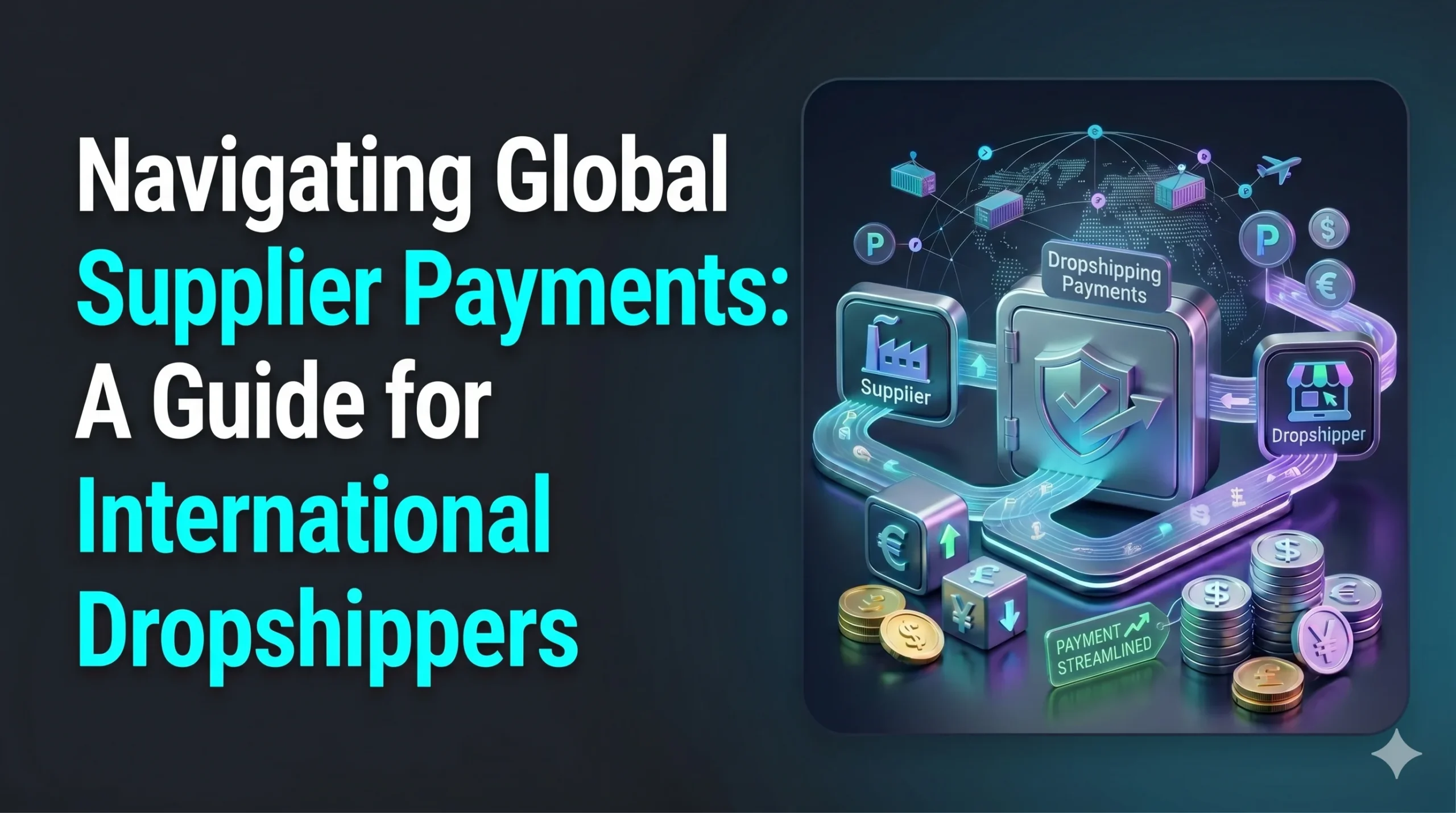
Most international dropshipping businesses follow a payment flow similar to this:
- Customer places order
- Marketplace or payment processor receives funds
- Seller transfers funds internationally
- Supplier receives payment
- Supplier ships product
- Seller reconciles payout and fulfillment costs
Each stage introduces potential friction related to:
- Currency conversion
- Settlement timing
- Banking fees
- Payment platform limitations
Optimizing these workflows improves overall operational efficiency.
Traditional Banks vs Fintech Payment Providers
Historically, many dropshippers relied on traditional banking systems for supplier payments.
However, fintech providers now offer alternatives focused specifically on cross-border commerce.
Traditional Bank Transfers
Advantages
- Established banking infrastructure
- Broad global recognition
- High transaction limits
Limitations
- Slow SWIFT settlement
- Intermediary fees
- Less transparent FX pricing
- Limited multi-currency flexibility
For smaller or mid-sized dropshippers, traditional banking costs can become disproportionately expensive.
Fintech Cross-Border Payment Platforms
Platforms such as:
provide infrastructure tailored for:
- Marketplace sellers
- Freelancers
- Agencies
- Import/export businesses
Common Features
- Multi-currency receiving accounts
- Local payout rails
- Competitive FX conversion
- Supplier payment tools
- Treasury management capabilities
These solutions often reduce friction compared to traditional international wire transfers.
Comparing Payment Infrastructure Options
| Feature | Traditional Bank | Fintech Payment Provider |
|---|---|---|
| SWIFT dependency | High | Lower |
| FX transparency | Often limited | Generally better |
| Multi-currency holding | Limited | Strong |
| Settlement speed | Slower | Faster |
| Supplier payment flexibility | Moderate | High |
| Marketplace integration | Limited | Extensive |
| Treasury optimization tools | Basic | Advanced |
| Operational scalability | Moderate | High |
The best option depends on:
- Transaction volume
- Supplier geography
- Currency exposure
- Withdrawal frequency
- Compliance needs
Multi-Currency Receiving Accounts: Why They Matter
One of the biggest operational improvements for international dropshippers is the use of multi-currency receiving accounts.
These accounts allow sellers to:
- Receive payments in original currencies
- Hold balances across multiple currencies
- Reduce unnecessary conversion cycles
- Control FX timing strategically
Example Workflow
Instead of:
- Receiving USD
- Converting USD to local currency
- Re-converting local currency into CNY for suppliers
a seller can:
- Receive USD
- Hold USD balance
- Pay supplier directly in USD or convert strategically
This reduces:
- Double conversion costs
- FX spread exposure
- Banking friction
How to Reduce Cross-Border Payment Costs
1. Monitor Effective Exchange Rates
Many providers advertise:
- “Low fees”
- “Zero transfer costs”
while embedding profit margins inside exchange rates.
The most important metric is:
Effective settlement rate vs interbank rate
Dropshippers should regularly compare:
- Mid-market rate
- Provider conversion rate
- Final supplier settlement amount
2. Consolidate Supplier Payments
Frequent low-value international transfers increase:
- Banking costs
- Operational complexity
- Compliance review frequency
Batching supplier payments can improve:
- Fee efficiency
- Treasury visibility
- Reconciliation accuracy
However, this should be balanced against supplier payment expectations and fulfillment speed.
3. Hold Strategic Currency Reserves
For businesses operating internationally, maintaining balances in:
- USD
- EUR
- GBP
can improve flexibility during FX volatility.
This allows sellers to:
- Time conversions more strategically
- Manage seasonal fluctuations
- Reduce forced conversions during unfavorable market conditions
4. Avoid Unnecessary Currency Cycling
One of the most expensive treasury mistakes is repeated currency conversion.
Example:
- USD → Local Currency → CNY
Every conversion layer introduces:
- Spread losses
- Transfer fees
- Settlement friction
Direct supplier payments in original settlement currencies are often more efficient.
Supplier Relationships and Payment Reliability
Reliable payments are essential for maintaining supplier trust.
Suppliers prioritize buyers who:
- Pay consistently
- Avoid transfer delays
- Maintain predictable payment schedules
Strong payment infrastructure can improve:
- Fulfillment priority
- Negotiation leverage
- Bulk pricing opportunities
- Long-term supplier partnerships
For high-volume dropshippers, treasury reliability can become a competitive advantage.
Compliance and Risk Management
Cross-border payment infrastructure operates under strict financial regulations.
International dropshippers should prepare for:
- Identity verification
- Business registration checks
- Source-of-funds reviews
- AML monitoring
- Beneficiary validation
Common Compliance Triggers
Payment providers may initiate reviews due to:
- Sudden transaction spikes
- Large international transfers
- High-risk supplier regions
- Unusual payment behavior
Maintaining organized documentation helps reduce disruption during compliance reviews.
Tax and Accounting Considerations
Global dropshipping businesses often underestimate accounting complexity.
Cross-border operations may involve:
- VAT/GST obligations
- Marketplace tax collection rules
- International invoicing requirements
- Multi-currency bookkeeping
Poor financial visibility can create:
- Margin distortion
- Reporting errors
- Tax compliance risks
Best Practices for Financial Visibility
Use accounting systems that support:
- Multi-currency reconciliation
- Marketplace fee tracking
- Supplier payment categorization
- FX gain/loss reporting
Automation becomes increasingly important as transaction volume grows.
Scaling International Dropshipping Operations
As businesses scale, payment infrastructure becomes a strategic asset rather than a simple operational tool.
Larger dropshippers often optimize:
- Treasury workflows
- Supplier payment cycles
- FX exposure management
- Working capital efficiency
- Payout consolidation
This helps improve:
- Liquidity resilience
- Inventory responsiveness
- International expansion capacity
Key Factors to Evaluate When Choosing a Payment Provider
Before selecting a provider, dropshippers should compare:
FX Conversion Costs
Evaluate:
- Spread vs mid-market rate
- Hidden conversion margins
- Effective settlement value
Supplier Payment Coverage
Confirm:
- Supported countries
- Settlement currencies
- Local banking rails
Withdrawal and Settlement Speed
Assess:
- Same-day vs multi-day transfers
- Local payout infrastructure
- Reliability during peak periods
Compliance Stability
Review:
- Documentation requirements
- Regulatory reputation
- Marketplace compatibility
Treasury and Scalability Features
Consider whether the provider supports:
- Multi-currency holding
- Bulk supplier payments
- Cross-border invoicing
- Working capital workflows
Frequently Asked Questions
What is the cheapest way for dropshippers to pay international suppliers?
The most cost-effective method depends on:
- Supplier location
- Currency corridor
- Payment volume
- FX conversion structure
Fintech providers often reduce costs compared to traditional SWIFT banking.
Why are FX spreads important in dropshipping?
FX spreads directly affect profit margins. Even small exchange-rate markups can significantly reduce net earnings for high-volume sellers.
Can dropshippers pay suppliers directly in USD?
In many cases, yes. Some suppliers accept USD settlements, which can reduce unnecessary currency conversion cycles.
Are fintech payment providers safer than traditional banks?
Both operate under financial regulations, though risk profiles vary by jurisdiction, provider licensing, and compliance standards.
Final Thoughts
For international dropshippers, supplier payments are no longer just a transactional process—they are a core component of operational efficiency and margin management.
As global e-commerce competition intensifies, businesses that optimize:
- Cross-border disbursements
- FX conversion workflows
- Multi-currency liquidity
- Treasury infrastructure
- Supplier settlement timing
are often better positioned to scale sustainably.
Platforms such as Payoneer, Wise Business, Airwallex, and PingPong Payments provide increasingly sophisticated tools for navigating international supplier payments, though the optimal solution depends heavily on business size, geography, and treasury complexity.
Before selecting any payment infrastructure, dropshippers should evaluate:
- Total FX costs
- Settlement reliability
- Supplier payment flexibility
- Compliance standards
- Scalability requirements
A disciplined cross-border payment strategy can help international sellers preserve margins, strengthen supplier relationships, and build more resilient global operations over time.